
By Steve Van Kooten (Posted by PDC Courier Press on 12/9/2025)
Getting a job is a difficult task, and for people with disabilities, the obstacles they face to even apply for work can seem insurmountable. In any given community there are dozens, hundreds or even more people who fall out of the workforce entirely due to a lack of support services.
But there are also people like Chris Fleshner, who managed to find a job and maintain employment with help from job development services.
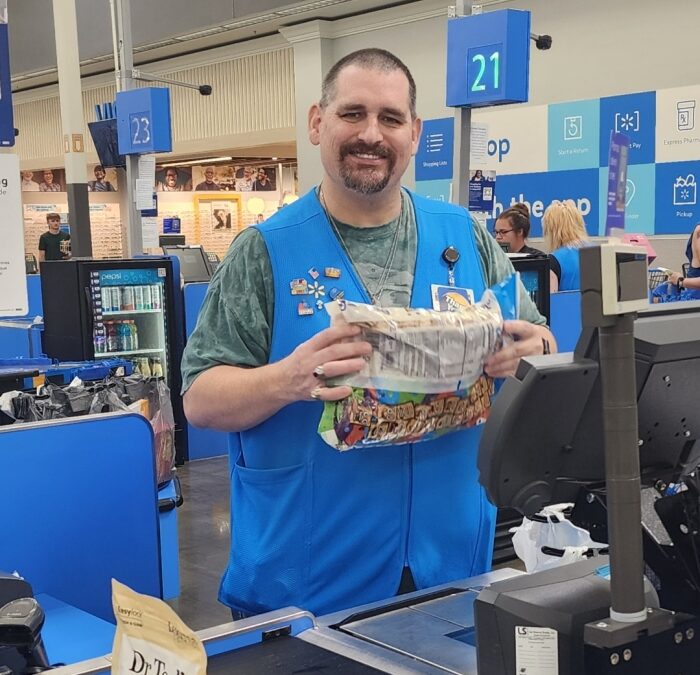
Fleshner began working as a part-time associate at the Walmart in Bridgeport this past January. Despite having many jobs in the past, he had not worked in nearly a decade before getting the job.
“There were barriers to employment. He had other means of employment in the past — a lot of things that didn’t work out. People didn’t always understand his situation,” said Kim Thompson, a community job developer for the Opportunity Center.
Thompson provides vocational services to many people with disabilities in Southwest Wisconsin, including Chris, who has a brain tumor.
Doctors found the tumor in 2012 and initially told him he had three months to live. Even though he’s had radiation treatment and multiple surgeries, the tumor cannot be removed because his optic vortex and carotid artery are inside of it.
His mother, Bobby, said that radiation treatment had a profound impact on her son’s cognitive abilities, making certain mental tasks more difficult for him, such as memory recall and speaking — skills he needs in the workforce.
Chris acknowledged he would’ve had a “hard time” finding work without help from Thompson and the Opportunity Center.
“He could not have found a job without her,” his mother recalled. “He lost many, many jobs before we found out there was a reason, and there are only so many jobs in Prairie du Chien.”
“There are a lot of people that can misjudge a person’s strengths and weaknesses, but it’s more about changing lives one job at a time,” said Thompson. “We shouldn’t classify individuals by their disability, and it shouldn’t limit them from trying to reach their goals.”
For someone like Chris, the proverbial deck is stacked against them. Job opportunities for people with diagnosed disabilities are far fewer than for a high school student or someone with a checkered job history; they can be relegated to jobs with low wages and few growth opportunities based on preconceived notions of reliability and capability — or rather unreliability and incapability.
Thompson advocated for Chris during the hiring process, assisting him to complete his paperwork, to evaluate different job opportunities and to access the on-the-job resources he needed to be successful.
Walmart seemed like the right fit for Chris because he’d already worked on a crew that helped with the store’s remodel years ago, and he loves interacting with people. But those connections didn’t automatically guarantee him a job. It was up to Chris to prove that he was employable. According to Thompson, he has achieved many of the skills he needed while working on the job, and Chris is proud to be fulfilling a purpose in life by assisting others.
While Thompson’s job is to support people through job development opportunities, Chris had to prove he could do the work. “Chris has really proven himself despite having the brain tumor,” she said.
“We do have a really good working relationship with Walmart,” said Thompson. “They employ other individuals through our program services. Everybody deserves a chance, disability or not.”
Thompson’s job varies depending on the client and the employer. In Chris’ case, Walmart provided on-site training in the different areas he needed to work in, while she provided “the side supports” to make sure both the employee and the employer benefited from the arrangement.
“He did really well learning to provide good customer service. After they saw what Chris has to offer, they were very happy to have him on board,” she said.
With a little less than one year on Walmart’s payroll, Chris has earned more than his paycheck. His supervisors have even allowed others interested in this type of work to shadow him.
“That means I’m going somewhere, and I’m doing the job right,” he said.
That’s not to say money doesn’t matter. Earning a paycheck is a powerful motivator, especially for those who were told they couldn’t. Chris said making money was more rewarding than getting it handed to him. There’s a sense of independence, pride and purpose.
“It makes me feel good to know that I earned that money,” he said.
Chris not only has to learn the same skills as everyone else at his workplace, but he also has to be a role model and set a good example by maintaining a positive relationship with his employer and his community. That’s because his success can help other people get the same opportunities.
“For somebody who hasn’t really been understood in society, this is his success story,” said Thompson. “He’s turned his life around. It’s doable — we shouldn’t let a disability define who we are.”